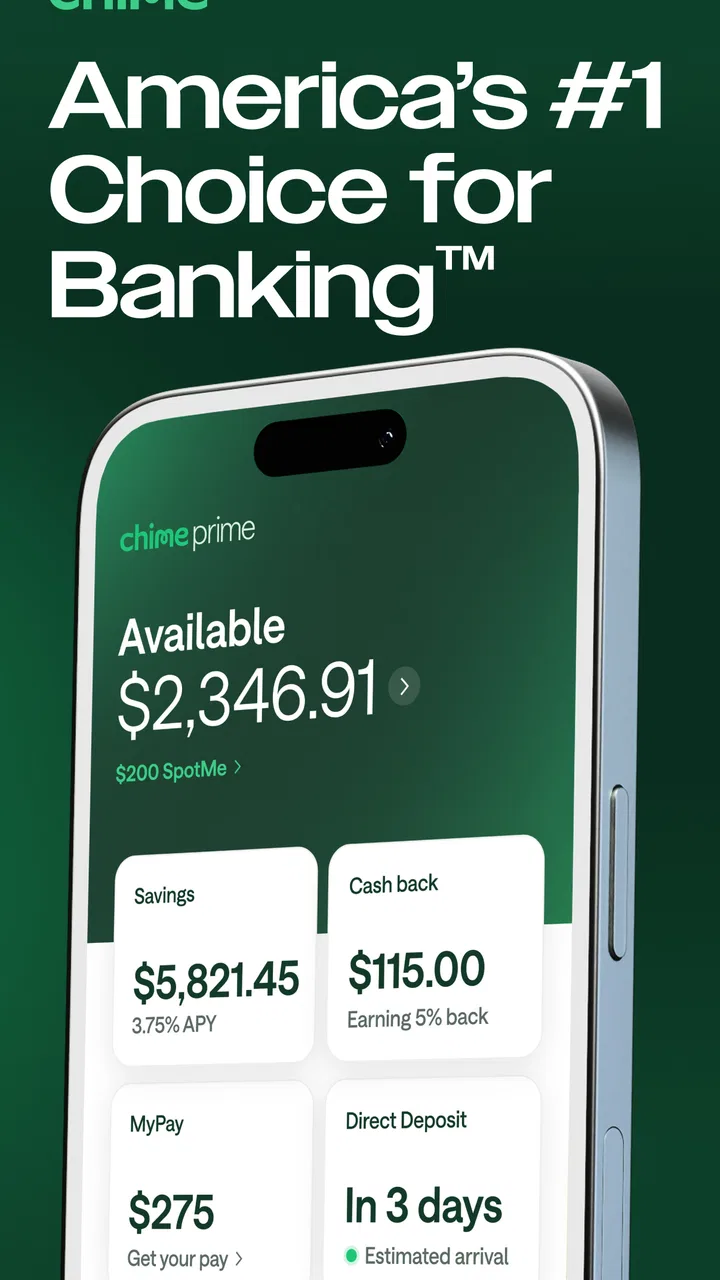
Chime® – Fee-Free Banking
- 4.7
- Rating
- 10.00M
- Installs
- Free
- Price

 Analysis by App-foxy
I found Chime most useful when I treated it as a personal banking tool that can also fit into a carefully coordinated household routine. The app is free, comes from Chime, and focuses on everyday money management rather than trying to replace every financial service in one place. Its appeal is easy to understand: no monthly fees, fee-free overdraft, and access to pay earlier than the usual payday schedule. In practice, though, the value depends on how clearly each person keeps their own account, spending decisions, and login details separate.
That distinction matters more than it might seem. A banking app can be convenient on a shared phone or used alongside a partner’s financial routine, but convenience should not become casual account sharing. I would recommend Chime to someone who wants a straightforward mobile-first account for regular spending and direct deposits. I would be more cautious for a household looking for built-in family management, joint-account tools, or a complete replacement for a traditional bank relationship.
How Chime fits into a shared household routine
I’d make the account’s role explicit before anyone else in the household relies on it: for example, one person can use Chime for personal purchases while shared bills stay assigned to the accounts already used to pay them. That keeps check-ins focused on whether a payment is covered, rather than turning one person’s banking login into a household tool. A simple shared calendar can then help everyone see when those responsibilities come due.
You May Also Like

 Blood Strike: 2.5 Anniversary
Blood Strike’s Loadouts Turn Every Drop Into a Tactical Gamble
A close look at Blood Strike’s custom loadouts: how fast access to signature weapons reshapes its battle royale rhythm, rewards preparation, and narrows the gap between fights.

 Pandora - Music & Podcasts
Pandora’s Music Is Easy to Start, but Harder to Recover
Pandora’s strength is its low-effort path from a seed to a station. Its weak spot is how much confidence it asks you to place in connection, setup, and quiet recovery.

 8 Ball Pool
 Is Built on Rivalries, Rematches, and Routine
A close look at the rivalries, rematches, shared routines, and unanswered safety questions that turn a quick pool match into a persistent mobile community.

 Samsung Music
’s Quiet Strength Is Playing What You Already Own
Its reach comes less from spectacle than from dependable access to a personal library. That simplicity is both the app’s strongest retention engine and its ceiling.

 AccuWeather: Weather Radar
AccuWeather Review: A Quick, Clear Forecast for Everyday Decisions
For everyday plans, the best forecast is the one you can understand quickly. AccuWeather makes rain timing, radar, and local conditions easy to act on, with a few trade-offs.

 Hill Climb Racing
Why Hill Climb Racing Still Turns Crashes Into One More Run
A tiny car, a bumpy hill and one more upgrade: Hill Climb Racing keeps resurfacing because its simple chaos makes every near-miss feel personal.
More From Our News Desk



A practical scenario for two adults
Imagine one person in a household uses Chime for everyday purchases while another person handles rent and long-term savings through a separate bank. The Chime user could use the app to watch their own balance, receive income, and manage spending without asking the other person to monitor every transaction. That arrangement can work well because the app stays focused on the individual account holder instead of turning a shared device into a shared financial identity.
The useful habit here is to decide in advance what the account is for. It might cover groceries, transport, subscriptions, or a personal spending allowance. Once that purpose is clear, the account history becomes easier to read. I found this more helpful than treating the app as an all-purpose household ledger. Chime can support coordination, but it does not remove the need for a simple agreement about who pays which bill and where shared money is kept.
On a family tablet or a phone passed between household members, I would avoid leaving the account open. A banking session should be treated differently from a streaming app or a shared shopping account. Sign out when the device is not exclusively yours, and do not save access details where another person can casually reach them. This is not a special Chime feature; it is a sensible boundary for any financial app.
The strongest household use is coordinated independence: each adult manages a separate account while discussing shared plans outside the app. That approach makes it easier to identify who is responsible for a payment and reduces the temptation to use one person’s login as a shortcut for everyone.
What setup feels important before the first deposit
Setting up a mobile bank account is not just a matter of installing the app and tapping through screens. Before relying on Chime for an important payment, I would make sure the account holder’s contact information is current and that the person understands how they will receive alerts and handle access. A small amount of preparation can prevent a stressful situation when the phone is lost, replaced, or temporarily unavailable.
I would also decide whether Chime is the main account for daily life or a secondary spending account. For a secondary role, it can be easier to keep the balance limited to the amount intended for ordinary purchases. For a primary role, the user should plan how rent, utilities, subscriptions, and emergency funds will be organized. The app may make the account visible, but it cannot decide which obligations should be paid first.
The early-pay feature deserves a careful explanation inside a household. Receiving eligible income earlier can improve timing, especially when a bill is due before the traditional payday. It should not be confused with earning more money. If someone starts spending as though an early deposit were extra income, the same cash-flow problem can simply appear sooner. I would use the feature as a timing tool, not as permission to increase the monthly budget.
The overdraft benefit needs the same discipline. Fee-free overdraft can be reassuring when a purchase arrives just before money does, but avoiding a fee does not make an overdraft harmless. I would still check the balance before nonessential spending and keep a small buffer when possible. In a shared household, everyone should know whether the account is being used as a spending account or as a temporary bridge between deposits.
Keeping accounts separate while coordinating money
Chime works best when coordination happens through clear conversations rather than shared credentials. A couple might agree that one person covers utilities while the other handles groceries, then review their own accounts separately. A parent might help a young adult create a spending routine without signing into the young adult’s account. These arrangements preserve responsibility, even when household members are working toward the same goal.
One practical workflow is to give each recurring expense a named place in the monthly plan, then use the app to check whether the account assigned to that expense is ready. This is more reliable than opening Chime only after a payment fails. I would also review transactions at a regular time each week, not just when the balance looks unexpectedly low. That review can reveal small repeating charges that are easy to overlook during busy days.
Another useful trade-off is separating visibility from control. It can be helpful for partners to tell each other that a payment has been made, but that does not mean both people need unrestricted access to every account. Chime is suitable for personal account management; it is not a substitute for a household agreement about transparency. If a family needs formal shared ownership or detailed permissions, a different banking arrangement may be a better fit.
This is also where Chime differs from a traditional branch-based bank. A conventional bank may feel more natural to someone who wants face-to-face assistance, several account types under one established relationship, or a familiar process for complex financial matters. Chime is more appealing to people who prefer handling routine banking from a phone and who value a simpler fee structure. Neither approach is automatically better; the right choice depends on how much support and structure the household expects from its bank.
Age, trust, and the limits of shared access
The app has an Everyone content rating, but that label should not be mistaken for a recommendation that children independently manage an account. Banking involves identity, legal responsibility, deposits, spending decisions, and privacy. In my view, the appropriate user is an eligible account holder who understands those responsibilities, not simply anyone old enough to use a phone.
For a teenager or young adult learning money skills, Chime could be part of a supervised conversation about budgeting and timing. The teaching should happen through agreed rules: how much is available for discretionary purchases, which expenses come first, and what to do when the balance is low. I would not hand over an unlocked shared device and assume the app itself will provide parental structure. The product should be paired with family guidance, not expected to create it.
Trust also includes knowing who can see notifications. If a phone displays banking alerts on its lock screen, another person nearby may learn that money arrived or a payment was made. I would review the phone’s notification behavior and use a private device whenever possible. This is especially important in households where phones are borrowed, repaired, or shared between adults.
For older relatives, the main question is comfort with mobile-only routines. Someone who dislikes managing passwords, updating a phone, or resolving account questions digitally may feel more secure with a bank that offers stronger in-person support. Chime can be convenient for an experienced smartphone user, but convenience is not the same as accessibility for every member of a family.
What everyday use is like
In daily use, I would open Chime for quick checks rather than long financial planning sessions. Before buying groceries, I could confirm the available balance. After a deposit, I could see whether it is sensible to pay a bill or leave the money untouched. That immediacy is the central strength of a mobile banking app: the account is close at hand when a decision needs to be made.
The downside is that quick access can encourage quick decisions. A balance screen tells me what is available, not what has already been promised to upcoming bills. I would keep a separate note or budget for fixed obligations, especially if several household payments arrive at different times. Without that second layer of planning, the app can make spending feel safer than it really is.
For someone paid on a regular schedule, early access may make a noticeable difference in how the week is organized. A deposit arriving ahead of the standard payday can help cover a scheduled expense without using another account. Still, I would check the timing of each real payment rather than assume every deposit will behave identically. The feature is useful when understood as part of a cash-flow plan, not when treated as an automatic solution to an income gap.
The free price is another reason the service is easy to try. There is no monthly subscription decision hanging over the account, which makes it more approachable as a dedicated spending account or a first step into mobile banking. Even so, “free” should not be read as “every possible transaction is free.” I would inspect the terms for the specific way I planned to add, move, or access money before making Chime the only account in the household.
Version, device fit, and long-term maintenance
The current version is 5.305.0, and the app requires at least iOS 10. That makes device compatibility worth checking before installation, particularly if a family member uses an older iPhone. A banking app should run on a device that still receives dependable security updates and can be protected with a lock screen. If the phone is too old to maintain comfortably, the account experience may become frustrating even if installation is possible.
I would keep the operating system and the app updated, use a unique access method, and avoid managing money over an untrusted public connection. These steps are basic, but they matter more for banking than for most everyday apps. On a shared device, I would also avoid letting another person’s convenience determine the account holder’s security settings.
The app has been available since Mar 28, 2014, and its scale suggests that it is not a brand-new experiment. It has over 10 million installs, a 4.7 average from around 958 thousand ratings, and around 228 thousand written reviews. Those figures indicate broad adoption, but they do not guarantee that every household will find the same level of support or flexibility. I treat popularity as a reason to investigate, not as a replacement for checking whether the product matches my needs.
Where it beats ordinary alternatives, and where it does not
Compared with a conventional checking account, Chime’s clearest advantages are its phone-centered experience, lack of a monthly fee, overdraft positioning, and early-payday appeal. Someone who wants a simple account for deposits and regular purchases may find less friction here than with a bank whose model revolves around branches or a larger menu of products.
Compared with a budgeting app, however, Chime is not the same kind of tool. A budgeting app may help someone compare several accounts, plan categories, or coordinate a household view. Chime is primarily the place where its own banking activity happens. I would not expect it to replace a detailed family budget, especially when partners keep money in different institutions.
Compared with a traditional bank, the trade-off is breadth and personal support. A household that needs complex borrowing, extensive account relationships, or in-person problem solving may prefer a full-service institution. Someone who wants a separate account for everyday spending and values mobile access may prefer Chime. The better choice is the one that matches the household’s financial complexity rather than the one with the most attractive single feature.
I would also skip Chime as the sole household solution if several people need formal authority over one pool of money. Shared bills are not automatically shared accounts, and a phone app cannot turn informal cooperation into a legally defined arrangement. In that case, I would look for a product specifically designed around joint ownership or use Chime only for the individual portion of the plan.
My household verdict
After looking at Chime through a shared-use lens, I see it as a strong personal banking option that can sit neatly inside a household plan, provided the boundaries stay clear. It is especially suitable for an adult who wants a free mobile account, early access to eligible pay, and protection from overdraft fees under the service’s terms. It is less suitable for families expecting built-in supervision, unrestricted shared visibility, or a complete replacement for every banking relationship.
My recommendation is to start with a defined job for the account. Use it for personal spending, a predictable group of bills, or a controlled cash-flow routine. Keep the login private, discuss shared obligations separately, and do not confuse early access or overdraft coverage with extra income. Those small decisions make the experience more dependable than simply installing the app and hoping the balance screen will manage the household for you.
For the right user, Chime feels practical and refreshingly direct. For a complicated family setup, it may need to work alongside another bank or budgeting method. I would recommend trying it when mobile-first banking matches the way you already manage money, but I would not choose it solely because it is popular or free. The best result comes from using its strengths for individual control while keeping household coordination deliberate and human.
FAQs for Chime® – Fee-Free Banking
01What is Chime, and how does it differ from traditional banks?
Chime is a mobile banking app that offers a modern approach to banking by eliminating many of the fees associated with traditional banks. It provides features like no monthly fees, no overdraft fees, and early direct deposit access. Unlike traditional banks, Chime operates entirely online, offering a streamlined and user-friendly experience through its app.
02Are there any fees associated with using Chime?
Chime prides itself on being a fee-free banking option. There are no monthly maintenance fees, no overdraft fees, and no minimum balance requirements. The app also offers free ATM access at over 60,000 locations. However, using out-of-network ATMs may incur a fee, so it's good to check locations before withdrawing cash.
03How secure is my money with Chime?
Chime takes security seriously, employing encryption and authentication measures to protect your personal and financial information. Your deposits are FDIC insured up to $250,000 through Chime's banking partners, The Bancorp Bank or Stride Bank, N.A. These measures ensure your funds are as safe as they would be with any traditional bank.
04How does Chime's early direct deposit feature work?
Chime offers an early direct deposit feature that allows you to receive your paycheck up to two days earlier than the standard payday. Once your employer submits payroll information, Chime processes the deposit immediately, making your funds available sooner than they would be with a traditional bank, which can be helpful for budgeting and managing expenses.
05Can I use Chime for all my banking needs?
Chime offers a comprehensive range of banking services, including checking and savings accounts, a Visa debit card, and features like automatic savings and spending tracking. While it covers most banking needs, it does not offer loans or credit cards. Users seeking a full-service bank might need additional services elsewhere.
Pros
- User-friendly interface for seamless navigation.
- No monthly fees or minimum balance requirements.
- Instant transaction alerts for better tracking.
- Offers early direct deposit access.
- FDIC insured up to $250
- 000.
Cons
- Limited customer service options available.
- No physical branch locations for in-person service.
- ATM fees may apply outside of network.
- Mobile check deposit can be slow at times.
- International transactions not supported.

Chime® – Fee-Free Banking
Gallery